Best IPTV for Sports: A 5-Point Scorecard for 2026
Why “Best” Depends on How You Measure It
Search for the best IPTV for sports and you’ll find plenty of lists ranking providers by channel count alone — but channel count is a weak predictor of how a service actually performs during the match you actually care about. A more useful approach is scoring providers against a small set of concrete criteria that determine real-world sports viewing quality, then testing the specific provider you’re considering against each one directly rather than trusting a marketing page.
Below is a 5-point scorecard covering the factors that consistently separate a genuinely reliable sports IPTV setup from one that only looks good until the first big match day.
Want to score a provider yourself before subscribing?
Request a Free Trial on WhatsAppThe 5-Point Scorecard
1. Peak-Load Server Stability
HIGHEST WEIGHTHow well a provider’s servers hold up during a title decider or a cup final, when a large share of subscribers are watching the same fixture simultaneously. This single factor separates the best IPTV for sports options from ones that only perform well on a quiet weekday test.
2. League & Competition Coverage Depth
HIGH WEIGHTWhether your specific leagues are covered by name, not implied by a vague “sports package” label — and whether overlapping broadcaster coverage exists so losing one feed doesn’t mean losing the match entirely.
3. Stream Quality & Bitrate
HIGH WEIGHTSports footage exposes weak bitrates faster than slower-paced content, since fast motion shows compression artifacts clearly. A genuinely strong sports tier holds detail during quick action, not just static wide shots.
4. Support Responsiveness During Live Events
MEDIUM WEIGHTHow quickly a provider responds if a specific match feed drops mid-game. A provider that fixes a broken feed within minutes during a live event scores far higher here than one that only replies the next day.
5. Device & Multi-Screen Flexibility
MEDIUM WEIGHTWhether your subscription plan supports enough simultaneous connections for how your household actually watches — one main screen, or a main screen plus a second device for an overlapping fixture.
How to Score a Provider Yourself
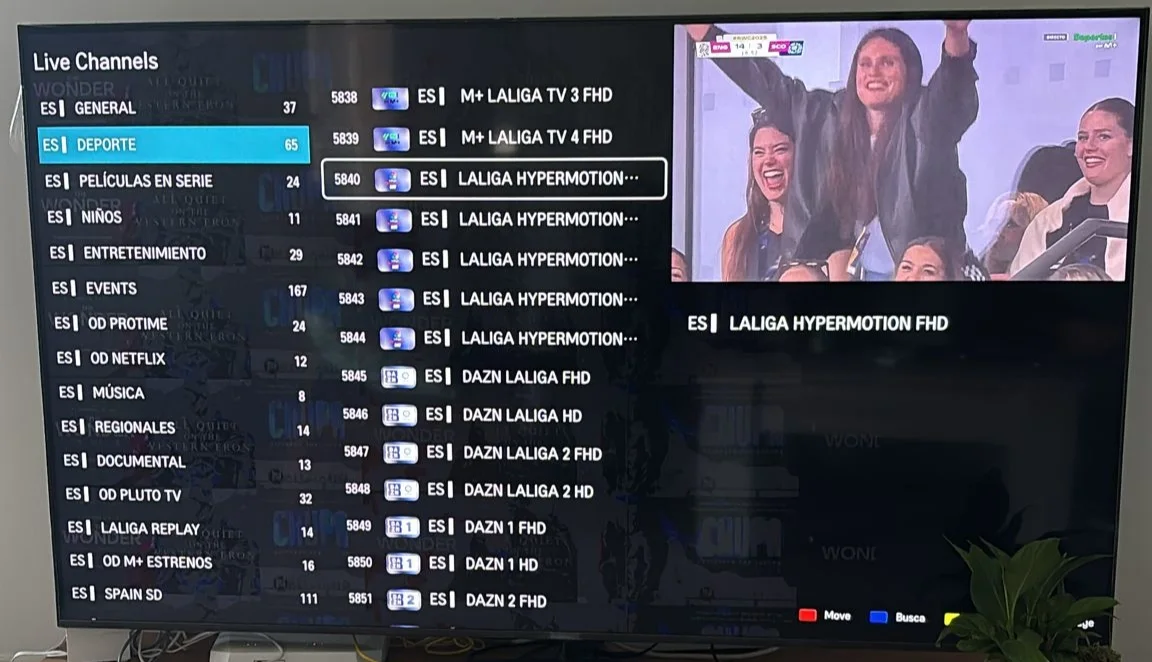
Applying this scorecard is straightforward during a free trial. Load the provider onto your actual device, check your specific leagues by name rather than trusting a category label, and watch during a real evening viewing window rather than an off-peak hour. If possible, time part of your trial around an actual live fixture rather than only browsing a static channel list, since that’s the only way to genuinely test criterion one — peak-load stability — which carries the most weight of any factor on this list.
Bandwidth Benchmarks for Sports-Grade Streaming
Sports content demands more consistent bandwidth than slower-paced programming due to constant motion. As a working benchmark, 12 Mbps supports standard-definition sports reliably, 28 Mbps is a solid target for HD, and 55 Mbps or more comfortably supports 4K sports streams without stutter, particularly during high-demand fixtures when server load is also elevated. A wired connection to your streaming device reduces dropped frames during fast game action compared to Wi-Fi alone.
| Quality Tier | Minimum Speed | Best For |
|---|---|---|
| SD | 12 Mbps | Unstable or capped connections |
| HD | 28 Mbps | Standard evening viewing |
| 4K | 55 Mbps+ | Major fixtures, strong connections |
Ready to run the scorecard yourself?
Ask Us on WhatsAppRed Flags That Lower a Provider’s Score
- No free trial offered: Makes it impossible to test criterion one before paying.
- Vague sports category labeling: “Sports package included” with no named leagues is a weak signal.
- Slow pre-sale response: A poor sign for how fast they’ll respond when a feed actually breaks mid-match.
- Single-source feeds only: No redundancy if one broadcaster source for a match has issues.
- Unclear device or connection limits: Leads to unexpected restrictions once you’re already subscribed.
Sports-Only Plans vs. Full IPTV Bundles
Some providers offer a sports-focused plan distinct from their general entertainment lineup, which is worth considering if live sports are your primary reason for subscribing. A narrower sports-only plan can sometimes be priced lower, though the best IPTV for sports isn’t necessarily the cheapest sports-only option — a full bundle from a provider that scores well across all five criteria above is often the safer overall choice, especially if your household also wants movies and general entertainment alongside sports.
Testing Multiple Providers Before Deciding
Since most reputable providers offer a short free trial, it’s reasonable to score two or three options against this same checklist before committing to any single one. Running the same evaluation consistently across providers — same devices, same evening timing, same specific leagues checked — produces a far more reliable comparison than judging based on marketing pages or advertised channel counts alone.
Applying the Scorecard to Multi-Sport Households
Households following more than one sport often weigh these five criteria differently depending on which sport matters most day to day. A household centered heavily on one high-demand league might prioritize peak-load stability above everything else, while a household following several lower-demand competitions might weigh coverage depth more heavily instead. There’s no universally correct weighting — the value of the scorecard is in making you think explicitly about which criteria matter most for your own household before comparing providers, rather than defaulting to whichever one has the flashiest homepage.
Why Channel Count Alone Misleads Sports Fans
A list advertising 100,000 channels sounds impressive, but a large share of that number is often duplicated, poorly labeled, or entirely dead by the time you actually try to watch. When narrowing down the best IPTV for sports specifically, it’s far more useful to check whether the exact leagues, teams, and broadcasters you personally follow are present and stable, rather than being swayed by a total number that says nothing about quality in the category that actually matters to you.
A provider with a tighter, well-maintained 20,000-channel list frequently outperforms one advertising five times that number once you’re actually trying to watch a specific match.
Understanding Feed Redundancy
One factor that separates the best IPTV for sports from an average option is whether a provider carries more than one source for the same fixture. Redundant feeds matter because a single broadcaster’s stream occasionally has technical issues independent of the IPTV provider itself — a second source for the same match means you’re not left without coverage if that happens. Asking a provider directly whether they maintain multiple sources for major leagues is a reasonable pre-sale question, and a clear, specific answer is a stronger signal than a vague assurance that “everything works fine.”
How Server Location Affects Sports Streaming
Server proximity to your actual location plays a meaningful role in stream stability, particularly during high-demand fixtures. Providers running servers geographically close to their customer base, or using a distributed multi-region setup, generally deliver lower latency and more consistent performance than those relying on a single distant server location. This is worth asking about specifically if you’re evaluating the best IPTV for sports options from outside the provider’s primary customer region, since latency differences become far more noticeable during a live, fast-paced sports broadcast than with on-demand content.
Evaluating Commentary and Language Options
Beyond raw stream stability, commentary language is worth factoring into any sports-focused evaluation. The best IPTV for sports setups often carry the same fixture from multiple regional broadcasters, letting you choose commentary in your preferred language rather than being stuck with whatever single feed a narrower provider offers. This is a smaller factor than server stability or coverage depth, but it meaningfully affects day-to-day enjoyment for viewers who have a strong preference for a specific broadcaster’s commentary style.
Second-Screen Setups for Overlapping Fixtures
Fans following more than one competition at once increasingly rely on a second screen — a tablet or phone — to keep an eye on an overlapping match while the main event plays on the primary TV. Confirming your subscription plan supports enough simultaneous connections for this kind of setup is directly tied to criterion five on the scorecard above, and it’s worth checking specifically if multi-screen viewing is part of your regular routine rather than assuming any plan automatically supports it.
Checking a Provider’s Track Record Before Committing
Beyond a single trial, it’s worth looking at how consistently a provider has performed over time rather than judging purely on one test session. Genuine customer feedback specifically about live sports performance during major events — not just general service reviews — is more useful here than star ratings alone, since a provider can score well on general reliability while still struggling specifically during high-demand sports fixtures.
Asking a provider directly how they’ve handled a recent major event, and how they’d describe their own uptime during it, is a reasonable way to gauge this before committing to a longer plan.
Balancing Price Against Scorecard Performance
It’s tempting to default to whichever provider offers the lowest price, but the best IPTV for sports rarely turns out to be the cheapest option once peak-load stability is factored in. Budget providers frequently cut corners specifically on server capacity, since that’s an ongoing infrastructure cost rather than a one-time expense — precisely the corner that matters most during the exact moments sports fans care about.
A provider charging a modest premium in exchange for consistently strong scores across all five criteria is generally a better long-term value than the cheapest option that only performs well during quiet, low-demand hours.
Putting It Into Practice: A Sample Evaluation
To make the scorecard concrete, imagine testing a provider ahead of a major weekend of fixtures. You’d confirm your specific leagues are listed by name, run a connection speed test against the bandwidth benchmarks above, and watch a live match during Saturday evening prime time rather than a quiet Tuesday afternoon.
You’d also send a test question to support and time their response, and check whether your plan supports a second device if needed. A provider performing well across all five of these concrete checks has effectively earned a strong score on the scorecard — no guesswork or marketing language required.
How Plan Length Interacts With the Scorecard
Once a provider scores well against all five criteria, plan length becomes a separate financial decision rather than a quality one. It makes sense to start with a short plan or trial specifically to validate the scorecard results firsthand, then move to a longer, better-value plan once you’ve confirmed the best IPTV for sports option for your household actually performs the way it claimed to during testing. Committing to a long-term plan before validating any of the five criteria firsthand adds unnecessary risk regardless of how attractive the advertised discount looks.
Adjusting the Scorecard for Casual vs. Dedicated Fans
Not every household needs to weight all five criteria equally. A casual viewer who watches occasional marquee fixtures might prioritize stream quality and ease of setup over deep coverage of every competition, while a dedicated fan following multiple leagues year-round should weight coverage depth and peak-load stability much more heavily. Applying the scorecard isn’t about finding a single universally “best” answer — it’s about identifying which of the five criteria matter most for how your specific household actually watches sports, then testing candidate providers specifically against those priorities.
What Happens When a Provider Fails the Scorecard
If a provider underperforms on one or more criteria during your trial — say, strong coverage depth but noticeable buffering during a live test — it’s worth deciding whether that specific weakness is a dealbreaker or a manageable tradeoff given your priorities.
A provider that scores highly everywhere except commentary language variety might still be the best IPTV for sports option for a household that doesn’t strongly care about that specific factor. The scorecard is meant to surface tradeoffs clearly rather than produce a single pass-or-fail verdict, letting you make an informed decision based on what actually matters to your own viewing habits.
Revisiting Your Score After a Few Months
A provider’s performance against this scorecard isn’t necessarily fixed once you subscribe — server infrastructure, broadcaster relationships, and support quality can all shift over time, for better or worse. It’s worth periodically revisiting how a provider scores on peak-load stability and coverage depth even after committing to a longer plan, particularly around major tournament windows when demand spikes and any underlying weaknesses tend to surface most clearly. Catching a decline early gives you more options than discovering it only when your next renewal decision is already due.
Combining the Scorecard With a Free Trial Checklist
Pairing the five-point scorecard with a short, structured trial checklist makes the whole evaluation process faster and more reliable. Rather than browsing a trial casually, work through it deliberately: search for each of your must-watch leagues by name, note whether EPG data loads correctly for those specific channels, and watch at least one live fixture during a realistic evening viewing window.
Treating the best IPTV for sports decision as a structured test rather than a casual impression consistently produces better long-term outcomes, since it removes the guesswork that leads many subscribers to discover problems only after committing to a longer plan.
Why This Approach Beats Reading Reviews Alone
Online reviews and forum recommendations can be a useful starting point, but they’re an imperfect substitute for testing a provider against your own specific needs. A review praising a provider’s general reliability says little about whether your particular league is well covered, or whether their servers held up during the exact fixture you cared about most.
The scorecard approach outlined here complements outside research rather than replacing it — use reviews to build a shortlist of candidates, then apply the five criteria yourself through an actual trial to make the final call on which is genuinely the best IPTV for sports for your household specifically.
Turning the Scorecard Into a Final Decision
After testing a provider against all five criteria, the decision usually becomes fairly clear. Strong, consistent scores across peak-load stability, coverage depth, and stream quality — the three highest-weighted factors — are a reliable green light to commit to a longer plan. Weaker results on any of the higher-weighted criteria are worth taking seriously even if the lower-weighted factors look fine, since those are the areas most likely to cause frustration during the exact moments a sports subscription is meant to deliver.
A Last Word on Setting Expectations
Even the best IPTV for sports option available won’t fully outperform the limits of your own internet connection or an outdated streaming device, so it’s worth pairing this scorecard with realistic expectations about your own setup. Occasional hiccups during unusually high-traffic events happen across the entire industry, even with top-scoring providers — what matters most is how quickly things stabilize afterward and how the provider communicates when it happens, both of which this scorecard is specifically designed to help you evaluate before you commit.
Final Thoughts
Finding the best IPTV for sports isn’t about chasing the single highest advertised channel count — it’s about scoring a provider against the criteria that actually determine whether your specific matches stay smooth when it matters most. Run this checklist during an actual live fixture, weight the criteria based on what your household watches most, and treat a strong trial performance as a far more reliable signal than any marketing claim.
Ready to run your own test?
Get Your Free 24-Hour TrialFrequently Asked Questions
What matters most when choosing the best IPTV for sports?
Peak-load server stability during major fixtures carries the most weight, followed by league coverage depth and stream quality.
What internet speed do I need for sports streaming?
Around 28 Mbps is a solid target for HD sports, with 55 Mbps or more recommended for 4K during high-demand fixtures.
How can I test a provider before subscribing?
A free trial timed around an actual live fixture is the most reliable way to score a provider against the criteria above.
Is a sports-only plan better than a full bundle?
Not necessarily — a full bundle from a provider that scores well across all five criteria is often a safer overall choice.
Why do sports streams buffer more than other content?
Fast motion demands more consistent bandwidth, and major fixtures draw significantly higher concurrent viewership than everyday programming.
Can I compare more than one provider before deciding?
Yes — running the same trial evaluation across two or three providers gives a more reliable comparison than judging by advertised claims alone.